

Transforming Asset Configuration with Kavia AI: DigitalT3’s 48-Hour BRD-to-Build Blueprint
This use case demonstrates DigitalT3’s GenAI SDLC in action using Kavia AI: an industrial-grade Asset Configuration Platform, built from a Business Requirements Document (BRD) to a fully tested, production-ready application in under two days—with Kavia AI as the primary engineer. What traditionally takes weeks of human development effort was executed autonomously, with a single human collaborator providing business context and validation.
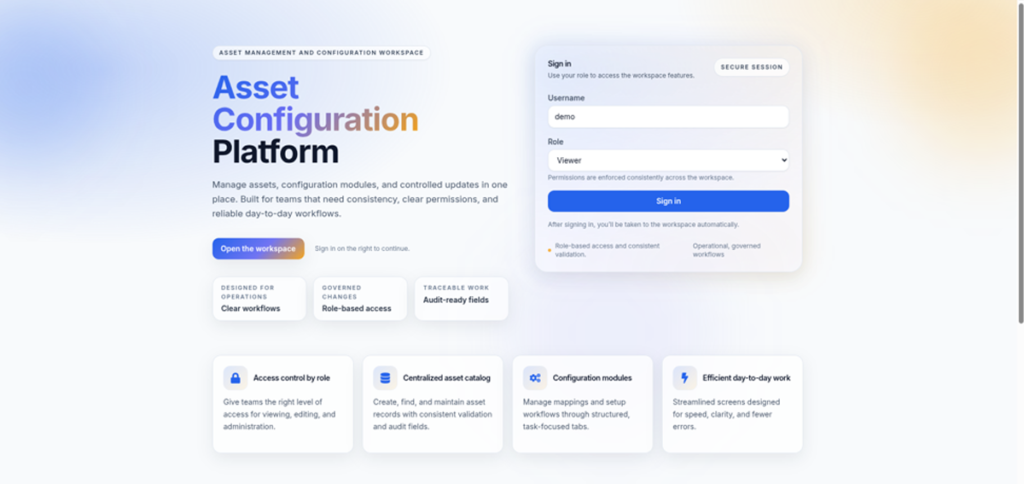
In the complex world of industrial operations and environmental compliance, managing asset lifecycles accurately is a monumental task. To address this, we developed a new Asset Configuration Platform — a governed enterprise workflow designed to synchronize downstream modules and maintain high-integrity data. This post explores the technique and technology behind this use case build, showcasing how DigitalT3 leverages Kavia AI to deliver enterprise software at unprecedented speed.
Target
Purpose and Value Proposition
Managing asset data for industrial and environmental compliance is an increasingly high-stakes, manual-intensive process. Existing approaches, often relying on disjointed spreadsheets or legacy systems, create fragmented data silos, high error rates, and significant compliance risks.
This platform was built to bridge that gap. By automating the translation of complex raw industrial requirements into a synchronized, governed application, it ensures that every asset in a facility—from boilers to turbines—is perfectly configured for compliance reporting and operational efficiency from day one. This provides a single source of truth, eliminates costly manual errors, and guarantees data completeness for mandatory reporting.
How It Can Be Used
- Operations Managers: Rapidly set up new assets or process streams while reducing configuration lead time by up to 90%.
- Compliance Officers: Ensure 100% data completeness and validity for environmental reporting (e.g., EPA, EU ETS).
- Solution Architects: Review as a definitive proof point for how AI Agents can generate complex, multi-tab enterprise applications from static documents.
Value Provided
- Requirement-to-Code Precision: The Kavia AI Agent directly mapped BRD sections to API endpoints and UI components, ensuring that no business logic was lost in translation.
- High-Fidelity Data Integrity: Through multi-tab validation and post-save replication, data remains consistent across Emission Factor (EF) mappings and throughput setups.
- Intelligent Replication: The “Smart Copy” feature preserves naming behaviors while automatically replicating complex equations and scalars to new target inputs.
- Audit-Ready Transparency: Every lifecycle action—Add, Edit, Copy, or Delete—is backed by a robust audit trail and correlation IDs for total traceability.
Technique: The Kavia AI Streamlined Workflow
The power of Kavia AI lies in its ability to collapse traditional development months into hours. The process is a seamless, high-velocity journey that rapidly translates business needs into a production-ready application.
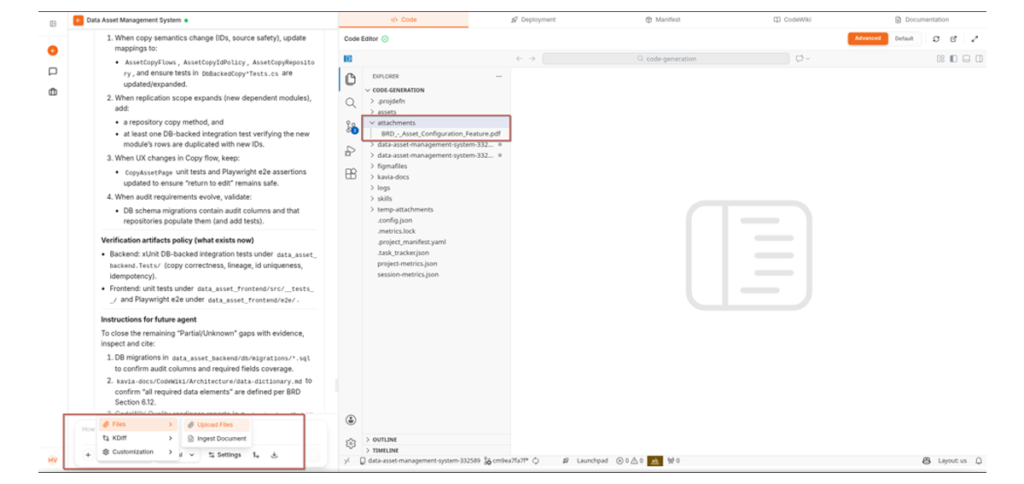
- Document Upload & Ingested Requirements The journey began with the upload of the Business Requirements Document (BRD). Kavia AI immediately ingested the text, performing an automated functional decomposition into user stories and technical tasks. Within minutes, it generated comprehensive functional requirements, mapping out the Asset Header, Status Logs, and critical mappings. It simultaneously established Non-Functional Requirements (NFRs), setting standards for audit trails, correlation IDs, and soft-delete logic.
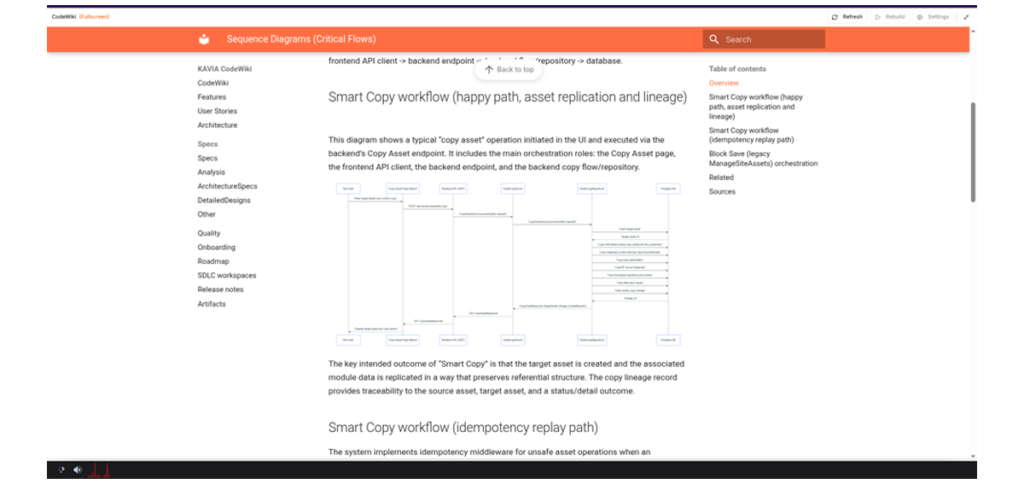
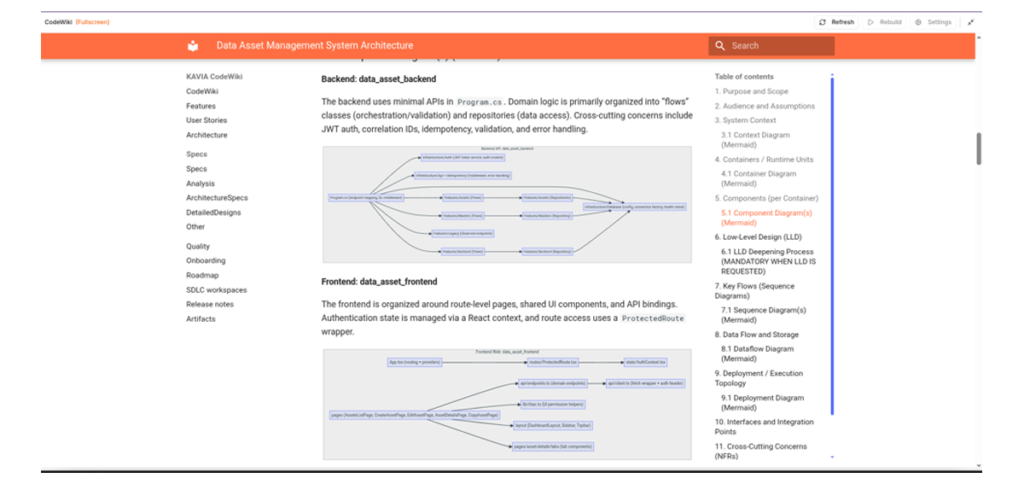
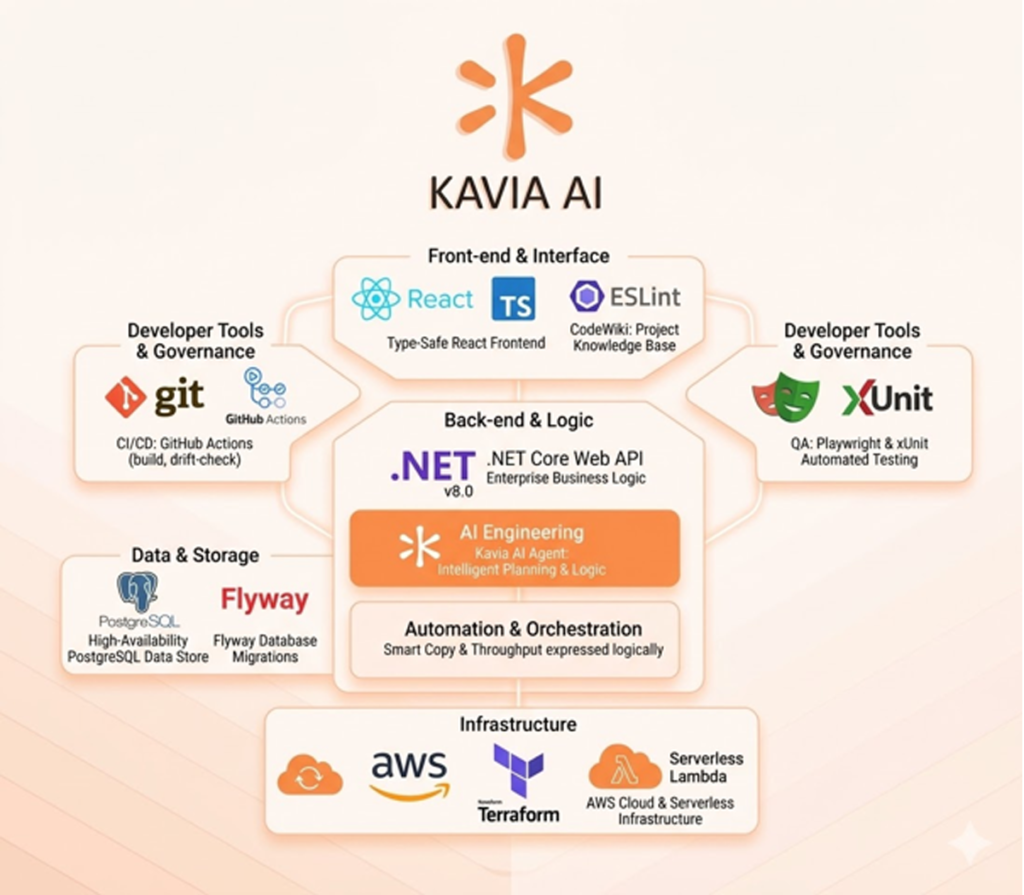
- Automated Architecture & Generated Design (HLD/LLD) Before a single line of code was written, Kavia AI utilized the CodeWiki to plan the project, generating a living technical blueprint. It defined the High-Level Design (HLD)—outlining the .NET microservice architecture and PostgreSQL schema—and the Low-Level Design (LLD). This included drafting complex sequence diagrams for operations like the “Smart Copy” logic and “Fallback Hydration,” while a data dictionary mapped the transition from legacy V2 structures to the optimized V3 schema.
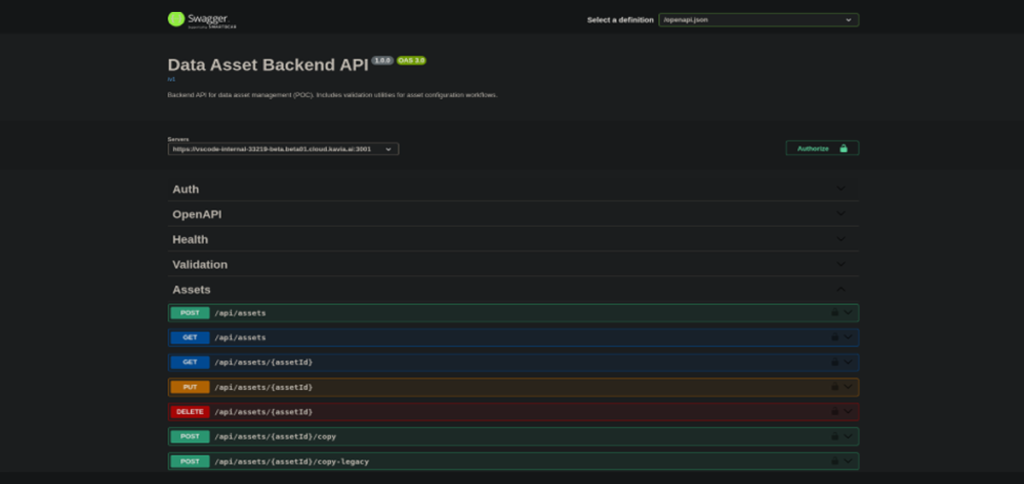
- Backend Implementation & Logic Hardening With the design finalized, the Agent implemented the backend as a secure .NET Web API. It focused on critical logic: establishing strict transactional boundaries to ensure that asset saves and child-row replications happened atomically, and unified error handling that mapped backend exceptions to user-safe “Problem Details” responses. All data was persisted in a PostgreSQL database, with schema changes versioned via Flyway migrations. For quality assurance, the Agent automatically generated a comprehensive suite of xUnit tests to verify route wiring and request validation.
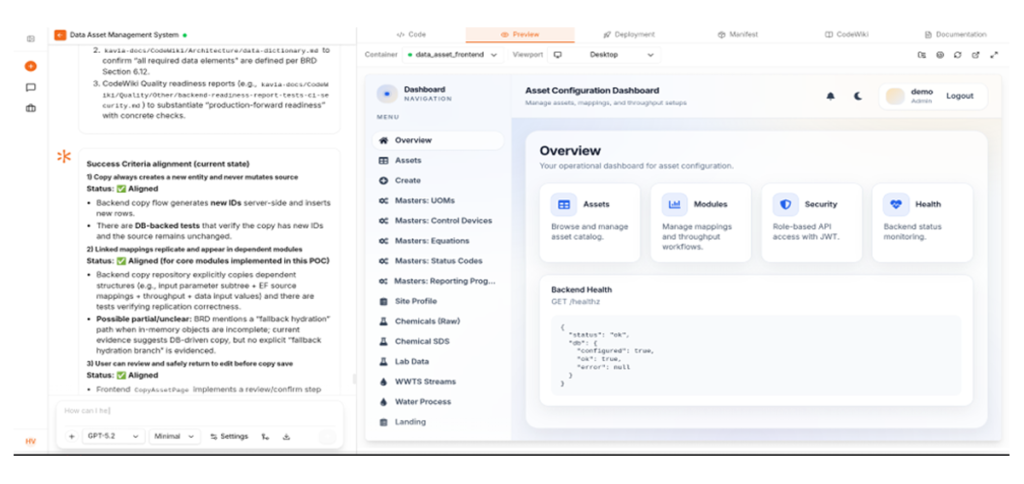
- Frontend Interface Build & Integrated Testing Kavia then generated a React + TypeScript frontend, designed to provide a dynamic and type-safe user interface. The UI was built to handle complex multi-tab forms—including Status Logs, Control Devices, and Fuel Mappings—with real-time, in-browser validation. This ensures high completion rates and accuracy for intricate data capture. Deterministic state management patterns were implemented to handle complex “Copy” and “Edit” states without data loss. Finally, the Agent authored a full set of Playwright E2E tests to automate verification of the entire user journey, from initial asset creation to final replication.
- Cloud Deployment & Governance
To ensure a secure, scalable, and audit-ready production environment, the platform was deployed using a serverless AWS Lambda architecture for the backend API.
The entire deployment pipeline was managed via GitHub Actions for CI/CD, which provided automated “OpenAPI drift checks” and build gates. Database versioning was handled by Flyway, ensuring that all schema changes were tracked and reversible.
Team: Human-AI Collaboration
This Asset Configuration Platform was brought to life through a “production-forward” mindset, moving from a static document to a live, production-grade application in record time. This model of human-AI collaboration represents the future of DigitalT3’s delivery capability.
Team Composition & Execution Model
- The Kavia AI Agent: Responsible for the end-to-end technical execution, including CodeWiki planning, HLD/LLD design, .NET API implementation, React/TypeScript UI development, and generating the full xUnit and Playwright test suites.
- Human Collaborator: Focused on providing the BRD context, clarifying unique environmental compliance logic, and confirming the “User-Safe” error standards.
This division of labor allowed the human collaborator to focus entirely on high-value business context and validation, while the AI Agent handled the entirety of the engineering, documentation, and testing effort. This synergy enabled us to deliver a complex, governed enterprise solution in just 48 hours—an outcome that typically requires 4-6 weeks of sprint cycles.
Conclusion
The Asset Configuration Platform epitomizes how DigitalT3 combines cutting-edge AI with enterprise-grade architecture. By positioning the Kavia AI Agent as the primary engineer—from HLD/LLD planning to integrated frontend testing—and leveraging a resilient .NET and PostgreSQL backbone, we have delivered a solution that is not just functional, but “source-safe,” reporting-ready, and production-complete. This use case is definitive proof that DigitalT3 can build complex, governed enterprise software at unprecedented speed, today.
See What We Built
This Asset Configuration Platform went from BRD to a fully functional, production-ready application in under 2 days, using Kavia AI as the primary engineer. Want to see what DigitalT3 can build for your requirements?
[Contact us to discuss your production use case build] — connect@digitalt3.com
DIGITALT3 remains committed to Bringing Digital & AI Together and enabling adoption across industries. For more information, visit our website at digitalt3.com.