
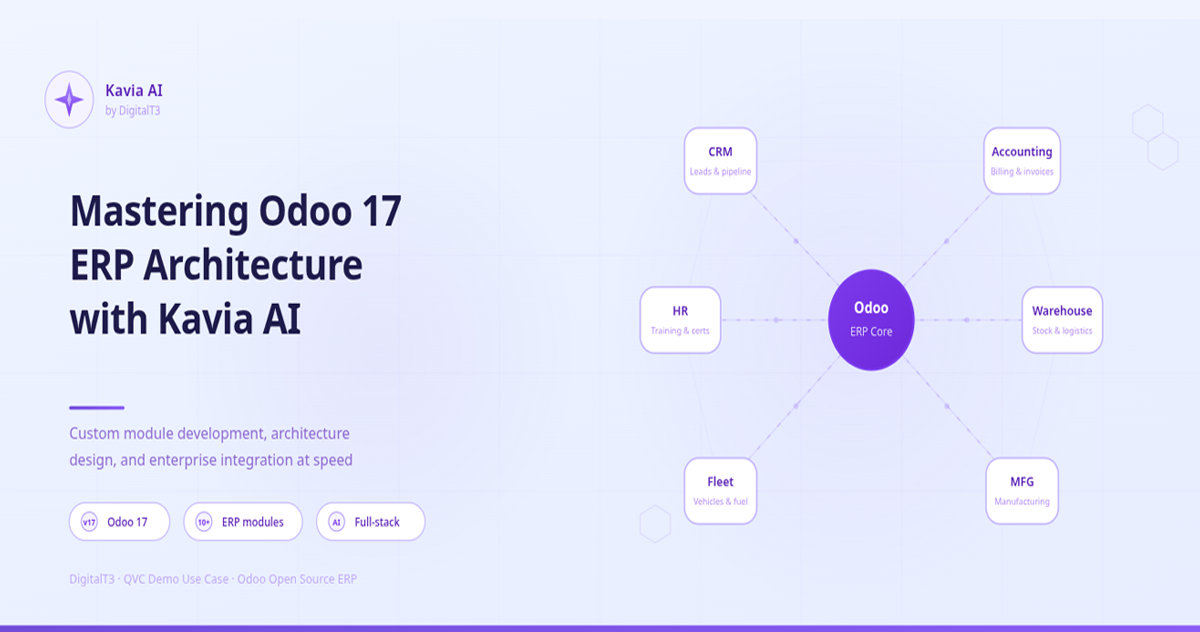
How DigitalT3 Harnesses Kavia AI to Scaffold, Engineer, and Test Complex Odoo Extensions in Record Time
With Kavia AI as the primary engineer, DigitalT3 demonstrated a definitive proof point in ERP modernization: a production-grade use case build ingesting the massive Odoo codebase to engineer two bespoke, API-enabled extensions — Employee Training and Fleet Management — from design blueprints to fully tested, production-ready applications in record time. Conventional human development cycles that require months of repository analysis and scaffolding were compressed into a rapid, continuous workflow.
Extending a complex, highly modular ERP like Odoo is conventionally a high-risk, time-intensive endeavor. Software development teams must first spend weeks understanding the massive, existing codebase structure and real-world ERP logic before writing a single line of extension code. The standard approach results in fragmented technical documentation, high risks during integration, and lengthy, manual-intensive test cycles. DigitalT3 collapsed this timeframe, deploying the Kavia AI Agent to ingest the complete Odoo repository and rapidly engineer, test, and expose new ERP modules in a structured, repeatable, “GAMP-like” software development lifecycle (SDLC). What follows is the full account of how Kavia AI made it possible.
Target
Purpose and Value Proposition
Extending enterprise-grade ERPs like Odoo demands rigorous alignment between business needs and technical correctness. Existing approaches rely on high manual effort for repository mapping, documentation writing, code scaffolding, and API exposure. This creates fragmented data silos, documentation drift, and high abandonment levels during delivery.
This platform was engineered to change that. By leveraging Kavia AI to ingest, analyze, and translate complex ERP structures into fully governed, production-ready modules, DigitalT3 delivered a system that guarantees structural correctness by default. It provides instant technical documentation, architecting a High-Level Design (HLD) and Low-Level Design (LLD) before code creation, enforcing ALCOA+ data integrity standards, and generating mandatory, auditable test logs. This results in airtight Odoo extensions and reporting readiness at unparalleled velocity.
How It Can Be Used
- ERP Architects: Access instant architectural blueprints and automated end-to-end workflow analysis of massive legacy repositories to speed up design decisions and modernization planning.
- Odoo Developers: Automate tedious groundwork — scaffolding Odoo-standard module structures (manifests, security rules, models, views) and boilerplate logic — focusing human effort on core business judgment and logic optimization.
- QA and Integration Leads: Rely on automatically generated Test Plans, Test Cases, and Unit Tests that execute database-free (JSON-based) validation logic directly within Kavia, and inspect automatically generated Swagger UI endpoints to confirm correctness.
Value Provided
- Requirement-to-Result Precision: The Kavia AI Agent ingested the raw Odoo codebase and directly mapped it to automatically generate complete, structurally correct module code (manifests, models, views, security) exactly matching the auto-generated HLD/LLD designs.
- Structured Architecture by Default: The Kavia Agent did not just “write code.” It acted as the lead architect, forced a “source-safe” methodology, and created the technical “Single Source of Truth” (HLD/LLD specs for models, rules, and validations) before engineering the logic, ensuring GAMP-standard execution.
- Instant API Enablement and Test Validation: Extension logic is immediately exposed through endpoints and visual Swagger UI visualization, while correctness is verified via automated, database-free JSON-based unit tests executed and validated directly within Kavia.
- Repeatable, Scalable Delivery Model: The methodology demonstrated on the initial Employee Training module — design-to-code-to-API — was successfully repeated for the secondary Fleet Management module, proving DigitalT3’s GenAI SDLC as a scalable model for any ERP modernization need.
Technique: The Kavia AI Streamlined Workflow
The technique used to modernize these extensions represents a fundamental shift in the ERP software development lifecycle (SDLC). We collapsed conventionally high-stakes engineering pipelines by positioning the Kavia AI Agent as the primary engineer — from codebase analysis to architectural design, logic implementation, and integrated testing.
Project Timeline
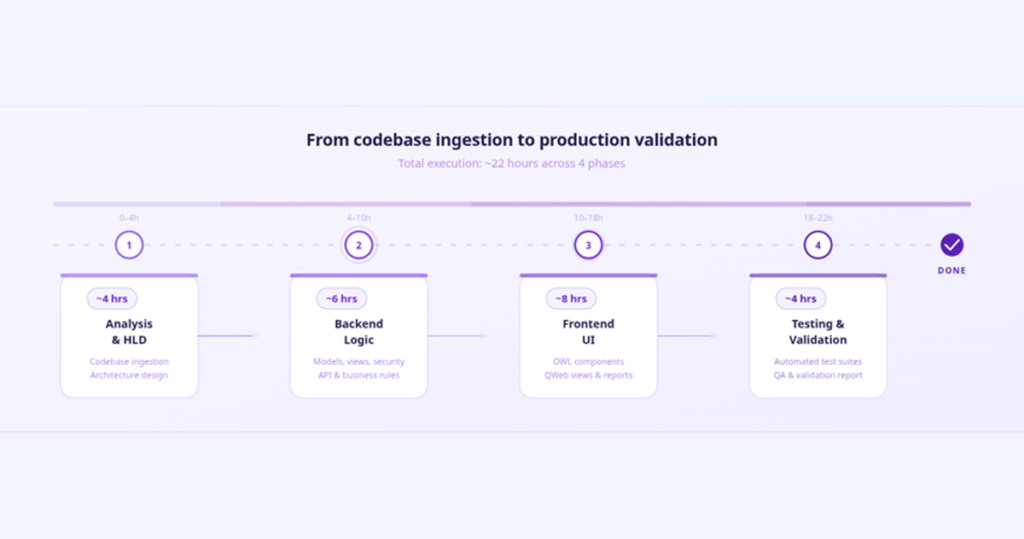
Total Execution: From codebase ingestion to production-ready modules in under 2 days.
1. Repository Ingestion and Code Analysis
The journey began with the upload of the massive, complex Odoo open-source repository into Kavia AI. Kavia immediately ingested the codebase and performed an automated End-to-End Workflow Analysis. Within minutes, the Agent drafted the complete high-level architectural documentation, explaining exactly how data flows across standard Odoo models, controllers, and APIs, providing instant context to the human collaborator.
2. Automated Architecture and Design Blueprinting
Before a single line of extension code was engineered, Kavia AI utilized the CodeWiki to maintain the technical “Single Source of Truth” and planned the project. The Agent finalized the comprehensive High-Level Design (HLD) and Low-Level Design (LLD). For the Employee Training (HR Management) extension, it explicitly defined models, security rules, and specific validation logic — translating requirement context into technical specifications with full traceability.
3. Module Engineering and API Enablement
Based on the generated design specifications, Kavia automated the complete module code creation. The Agent engineered Odoo-standard manifests, views, models, security files, and supporting logic with perfect fidelity to the design specs. Simultaneously, Kavia executed API enablement, instantly exposing the new functionality through production-ready API endpoints and Swagger UI visualization for easy external consumption and validation.
4. Automated Testing and Scalable Repeatability
Kavia automated the verification scope by generating and executing the testing and validation pipeline. It created an automated Test Plan, Test Cases, and Unit Tests for newly generated modules. Critically, these tests execute database-free validation logic (JSON-based) directly within Kavia, and generate detailed test results and validation reports to confirm correctness and build confidence. To prove the scalability of this AI SDLC model, the same structured design-to-code-to-API methodology was successfully repeated across a secondary domain (the Fleet Management Module).
5. Deployment and Governance
To ensure a secure, scalable, and audit-ready production environment, the completed Odoo modules were packaged following Odoo-standard deployment conventions. The entire development pipeline was managed via GitHub for source control and GitHub Actions for CI/CD, providing automated linting, test execution, and module packaging at every build stage. This methodology ensured that the final deployed modules were structurally complete, source-safe, and ready for integration into any Odoo 17 production instance.
Team: Human-AI Collaboration
This Odoo repository modernization use case was brought to life through a “production-forward” mindset, moving from standard codebase ingestion to production-grade applications in record time. This model of human-AI collaboration represents the future of DigitalT3’s delivery capability.
Team Composition and Execution Model
- The Kavia AI Agent: Responsible for the full end-to-end technical scope: codebase analysis, technical documentation writing, CodeWiki/HLD/LLD architectural design, complete module scaffolding and code generation across both platform experiences, API endpoint exposure with Swagger UI showcase, and automated generation and execution of JSON-based unit tests and validation suites.
- The Human Collaborator: Focused on providing the ERP modernization goals, Odoo module design requirements, and business logic validation rules, while confirming the “User-Safe” error standards.
This division of labor allowed the human collaborator to focus entirely on high-value business context and validation, while the AI Agent handled the entirety of the engineering, documentation, and testing effort. This synergy enabled us to deliver complex, governed ERP modernization extensions in 48 hours — an outcome that typically requires 4–6 weeks of sprint cycles.
Conclusion
The Odoo ERP modernization use case epitomizes how DigitalT3 combines cutting-edge AI with enterprise-grade ERP architecture to modernize legacy systems. By positioning the Kavia AI Agent as the primary engineer — from HLD/LLD planning to integrated testing — and leveraging resilient Python backend logic with Odoo’s proven framework, we have delivered production-grade ERP extensions that are not just functional, but source-safe, reporting-ready, and production-complete. This is definitive proof that DigitalT3 can extend and modernize complex ERP platforms at unprecedented speed, today.
See What We Built
This Odoo integration workflow went from standard codebase ingestion to fully functional, API-enabled HR and Fleet Management modules with automated test suites in record time, using Kavia AI as the primary engineer. Want to see what DigitalT3 can modernize or build for your enterprise requirements?
Contact us to discuss your ERP modernization build — connect@digitalt3.com
DIGITALT3 remains committed to Bringing Digital and AI Together and enabling adoption across industries. For more information, visit our website at digitalt3.com.