
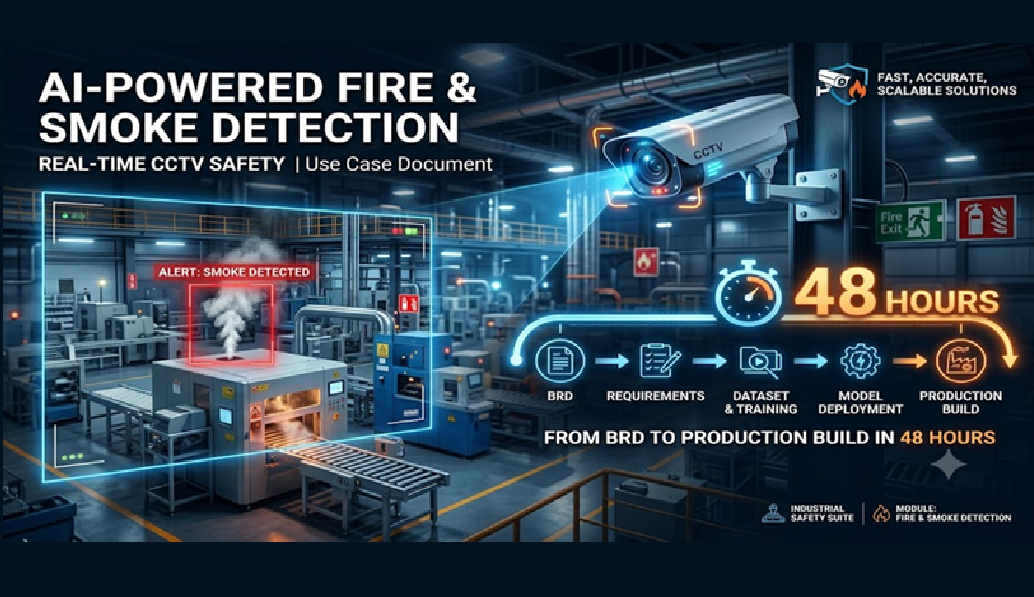
Accelerating Fire Safety Engineering with AI: A 2-Day BRD-to-Build Blueprint for Real-Time CCTV-Based Fire & Smoke Detection and Incident Response Monitoring — Platform Layer Engineered to Production Standard; Demonstration Build
This production use case build demonstrates a full end-to-end, prompt-engineering-driven SDLC in action: an industrial-grade Fire & Smoke Detection and Incident Response Platform, architected directly from a Business Requirements Document (BRD) and built on a pre-trained YOLOv8n computer vision model, into a fully functional, stakeholder-ready, cloud-native application in just 48 hours. What typically requires months of human sprint cycles — requirements analysis, AI infrastructure design, backend services, incident data pipelines, and enterprise frontend dashboards — was executed methodically through structured AI collaboration, with the Principal Solution Architect directing and the AI acting as lead engineer across every layer.
Managing fire and smoke safety across industrial facilities, warehouses, and monitored sites is one of the most time-critical operational challenges in the EHS and facility management sector. Ensuring early detection of fire and smoke across multiple zones and CCTV-monitored areas cannot be reliably enforced through human observation alone. Observer fatigue, delayed inspection cycles, absence of photographic evidence, and the impossibility of simultaneous multi-zone monitoring leave organisations exposed to catastrophic asset damage, regulatory liability, safety incidents, and audit failures.
The platform delivers always-on AI-driven fire and smoke detection, real-time alert generation, per-zone incident localisation, and executive-grade analytics dashboards — backed by annotated photographic evidence and a full audit trail. The following is the detailed account of how this platform was engineered from BRD to production in 48 hours.
Target
Purpose and Value Proposition
The core mandate for fire safety in regulated industrial environments is strictly defined by regulations including BS 5839, NFPA 72, ISO 7240, and the Regulatory Reform (Fire Safety) Order 2005 in the UK. Manual fire watch workflows are fragile — introducing significant risk during site operations, compliance spot-checks, and incident reporting. Relying on CCTV footage reviewed only after incidents, manual patrol logs, and disjointed inspection rosters leaves massive traceability gaps and creates a reactive rather than preventive safety posture.
This platform was engineered to eliminate those gaps. By leveraging a structured AI-driven build process to translate complex operational requirements into a fully governed, automated detection system, the team delivered a platform that identifies fire and smoke events in real time, generates evidentiary snapshots at the moment of detection, and maintains a complete audit trail satisfying the traceability standards required by fire safety compliance frameworks.
How It Can Be Used
- HSE Directors / EHS Managers: Monitor live detection rates, active alert volumes, and incident trends across all monitored zones via the executive KPI dashboard. View incident timelines and drill into specific fire/smoke events for audit readiness.
- Site Supervisors / Safety Officers: Receive real-time push alerts the moment a fire or smoke event is detected. Review annotated photographic evidence directly in the platform and acknowledge alerts with a traceable digital action.
- Platform Architects / Engineering Leads: Access production-ready backend service architecture built on SOLID principles, a clean FastAPI layer with REST and WebSocket endpoints, Supabase PostgreSQL repositories, and Docker Compose deployment topology.
- Quality & Compliance Auditors: Execute full audit readiness by inspecting incident evidence packages, tracing alerts back to originating detection events, verifying annotated snapshot URLs in Supabase Storage, and reviewing the complete event and alert audit log.
- Executive Stakeholders / Innovation Teams: Open the enterprise React dashboard and experience a fully working, stakeholder-presentation-ready AI fire safety monitoring platform — from live stream detection through evidence forensics and analytics — with minimal environment setup via Docker Compose.
Value Provided
- Requirement-to-Code Precision: Every high-level fire safety requirement — from real-time flame and smoke detection to temporal persistence validation — was mapped directly to production FastAPI endpoints, Pydantic validation schemas, Supabase repository methods, and React dashboard components. The rule engine, temporal smoothing logic, and event deduplication mechanism were all implemented in strict alignment with the original BRD specification.
- Sub-2-Second Detection Latency with Deliberate False-Positive Suppression: The YOLOv8n inference pipeline completes single-image detection in under 200ms on CPU and under 50ms on GPU in testing — raw detection is very fast. Confirmed incident alerts are intentionally held back by the temporal persistence engine (fire: 2-second minimum window; smoke: 3-second minimum window) to suppress false positives from reflections, steam, or transient frame noise. A confirmed fire alert therefore reaches the dashboard within approximately one second of the persistence window closing (~2–3s end-to-end); a smoke alert within roughly one second after its 3-second window (~3–4s end-to-end). The persistence windows are a deliberate safety feature, not a constraint — they ensure every pushed alert represents a genuine incident.
- Evidence-First Safety Enforcement: Every confirmed fire or smoke event triggers an annotated snapshot generation pipeline: bounding boxes, class labels, and confidence scores are rendered directly onto the captured frame, uploaded to Supabase Storage, and linked to the event record with a permanent public URL. Incident response teams receive photographic evidence for every alert without manual screenshot workflows.
- Zero Model Training Overhead: The platform treats the pre-trained YOLOv8n model (best.pt — trained for 150 epochs on the Roboflow fire-and-smoke dataset, optimised for high-speed and edge-device inference) as a production-ready external AI asset. No dataset collection, labeling, fine-tuning, or training infrastructure was required. The full engineering effort was invested in the platform layer around the model.
Model Asset & Attribution: The platform utilises the best.pt model weights from the fire-and-smoke-detection-yolov8 repository created by luminous0219 (https://github.com/luminous0219/fire-and-smoke-detection-yolov8).
Licensing & Compliance Note: The core YOLOv8n model architecture and pre-trained weights are governed by the GNU AGPL-3.0 License via Ultralytics. While the surrounding enterprise platform layers (FastAPI backend infrastructure, Supabase data pipelines, and React dashboard) are engineered to a production-ready standard, any commercial production deployment of the underlying model asset must strictly adhere to AGPL open-source copyleft provisions or secure an upstream commercial enterprise license from Ultralytics.
- Complete Audit Trail by Default: Every detection, event, alert, and acknowledgement action is logged in Supabase with UTC timestamps, camera source attribution, and user identity. The event lifecycle — NEW → ACTIVE → ACKNOWLEDGED → RESOLVED — is fully traceable, providing the complete audit evidence required for fire safety incident reporting and regulatory inspection.
Technique: The Kavia AI Streamlined Workflow
The technique used to build this platform represents a fundamental shift in how fire safety software systems can be engineered. Traditional delivery of a platform of this complexity — encompassing computer vision AI services, real-time streaming architecture, a multi-table cloud database, an enterprise React dashboard, and production Docker deployment — would typically require 4–6 weeks of sprint cycles across specialised engineers.
This delivery compressed that timeline to 48 hours by positioning a structured, prompt-engineering-driven AI collaboration workflow as the primary delivery mechanism. The Principal Solution Architect acted as strategic director, compliance authority, and integration decision-maker — directing the AI through a three-stage build pipeline that sequentially produced every platform layer from architecture documentation through to deployed frontend.
Crucially, the AI did not just “write code.” It acted as the lead architect and planner — ingesting the full BRD, decomposing requirements into functional service boundaries, generating sequence diagrams for complex operations like the RTSP stream inference pipeline and the alert lifecycle state machine, and producing enterprise-grade implementation decisions. This rigorous AI-driven planning phase minimised requirement drift and ensured the YOLOv8n inference singleton pattern, temporal rule engine, and Supabase repository architecture were designed correctly before a single line of implementation code was produced.
|
The Platform Stack Defined at Architecture Stage: React + TypeScript + TailwindCSS + Framer Motion (Frontend) │ Python 3.11 + FastAPI + Ultralytics YOLOv8n + OpenCV (Backend) │ Supabase PostgreSQL + Supabase Storage (Data) Model Asset: YOLOv8n best.pt — Fire and Smoke Detection (luminous0219). Trained for 150 epochs on Roboflow fire-and-smoke dataset. Architecture: YOLOv8n (Nano) — optimised for high speed and edge-device efficiency. Two detection classes: fire and smoke. Treated as a production-ready external asset — zero retraining required. |
Project Timeline and the 2-Day Build
Below is the high-velocity pipeline followed to build the Fire & Smoke Detection & Incident Response Platform from BRD to a fully functional, stakeholder-ready application:
- Requirement Ingestion and Solution Architecture Design
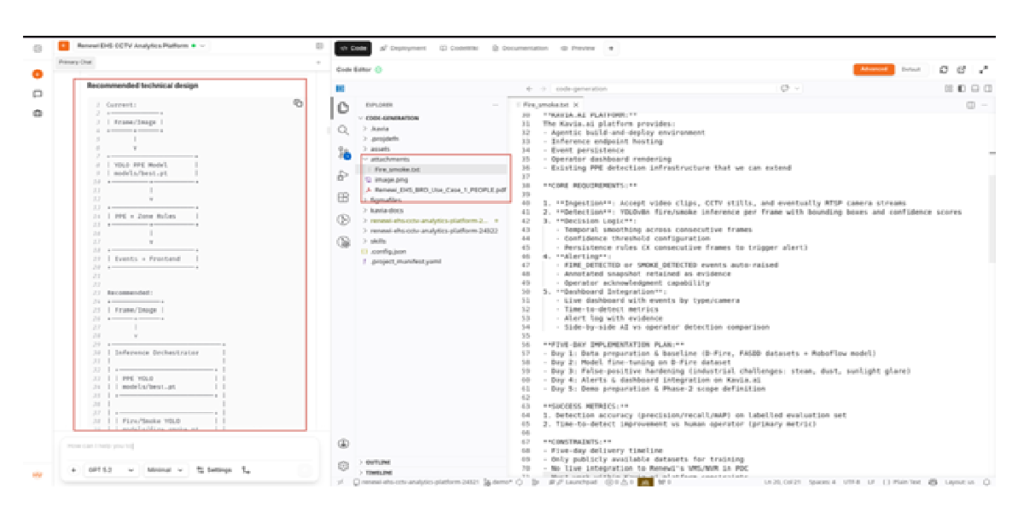
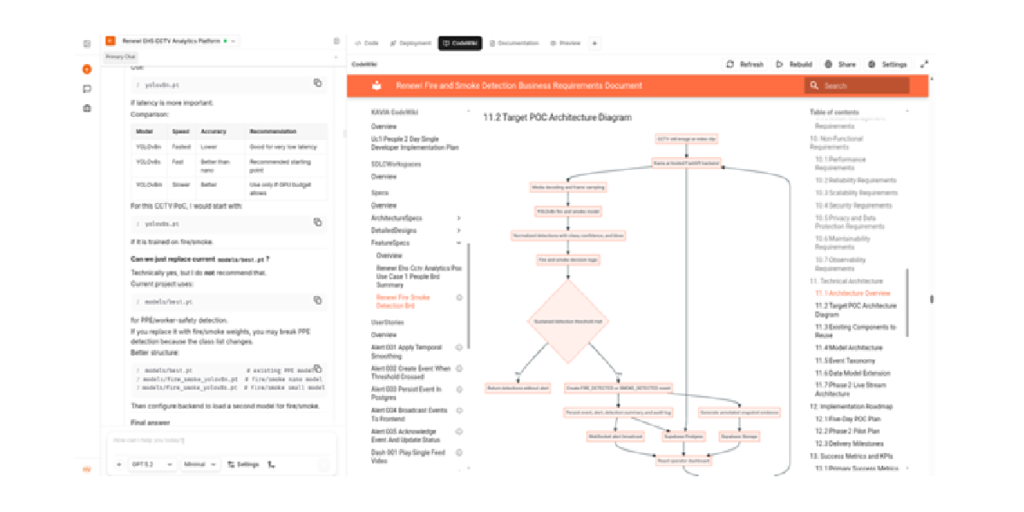
The build began with the AI ingesting the Fire Safety BRD in full, performing an automated decomposition into user stories, functional requirements, and non-functional requirements. Within the first session, the AI drafted a complete 22-section Solution Architecture Document (SAD) covering Executive Summary, Business Context, Objectives, Scope, Assumptions, Constraints, all Functional and Non-Functional Requirements, End-to-End Architecture, Component Architecture, AI/ML Architecture, Data Flow Architecture, Security Architecture, Integration Architecture, and Deployment Architecture.
It generated detailed Mermaid-syntax architecture diagrams for the full system topology, the AI inference pipeline, the alert lifecycle state machine, and the Supabase integration layer — establishing the complete engineering blueprint before any implementation began. Technology stack decisions were formally documented at this stage with explicit rationale for each choice, ensuring architectural consistency across all subsequent build phases.
- Backend Implementation — FastAPI + YOLOv8n AI Services
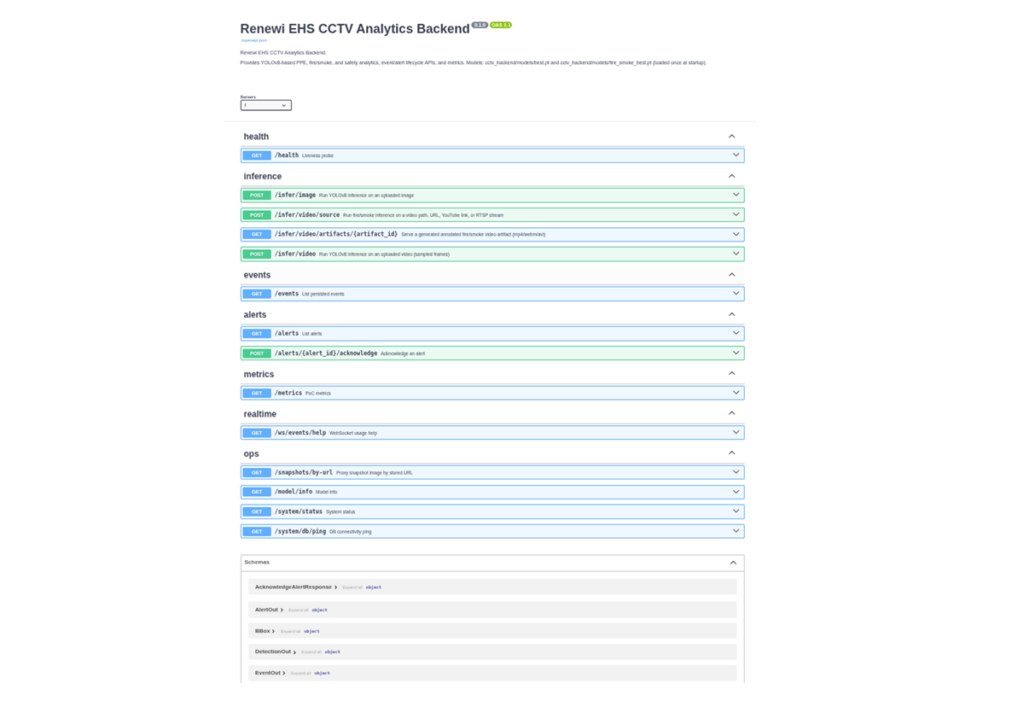
With the architecture blueprint established, the AI implemented the backend as a robust Python 3.11 microservice architecture using FastAPI, built around a singleton YOLOInferenceService that loads the fire/smoke best.pt model exactly once during application startup via the FastAPI lifespan context manager. The model is never reloaded per request, ensuring consistent sub-200ms inference latency (observed in testing) across the service lifetime.
The backend delivered the following core service components:
- YOLOInferenceService: Singleton model loader and inference orchestrator supporting image upload, video file processing with configurable frame sampling, and RTSP live stream processing. Runs inference in a thread pool executor to preserve async FastAPI event loop performance. Detects two object classes: fire and smoke.
- RuleEngine + TemporalPersistenceEngine: Evaluates detections against fire and smoke confidence thresholds. Enforces configurable persistence windows (fire: 2-second minimum, smoke: 3-second minimum) before incident confirmation, preventing false positive alerts from transient reflections, steam, or frame noise.
- CameraZoneEngine: Polygon-based digital zone mapping using zones.yaml camera configuration. Associates each detection event with its originating camera zone for precise incident location attribution.
- AlertService + EventService: Full event lifecycle management (NEW → ACTIVE → ACKNOWLEDGED → RESOLVED) with deduplication logic preventing duplicate alert storms for ongoing fire or smoke events.
- SnapshotService: Renders annotated incident frames with bounding boxes and confidence scores using OpenCV, uploads to Supabase Storage, and writes the public URL to the event record in PostgreSQL.
- Supabase Repository Layer: Clean repository classes for all five database tables — events, alerts, detections, audit_logs, users — with async Supabase client integration and structured error handling.
The AI also established the clean folder architecture: src/api/, src/services/, src/repositories/, src/core/, src/schemas/, src/config/, src/middleware/, src/utils/ — strictly enforcing separation of concerns and SOLID principles throughout. For quality assurance, a comprehensive Pytest unit test structure was generated covering route wiring, inference service contracts, rule engine logic, and repository interaction patterns.
- Frontend Build — Enterprise React Dashboard
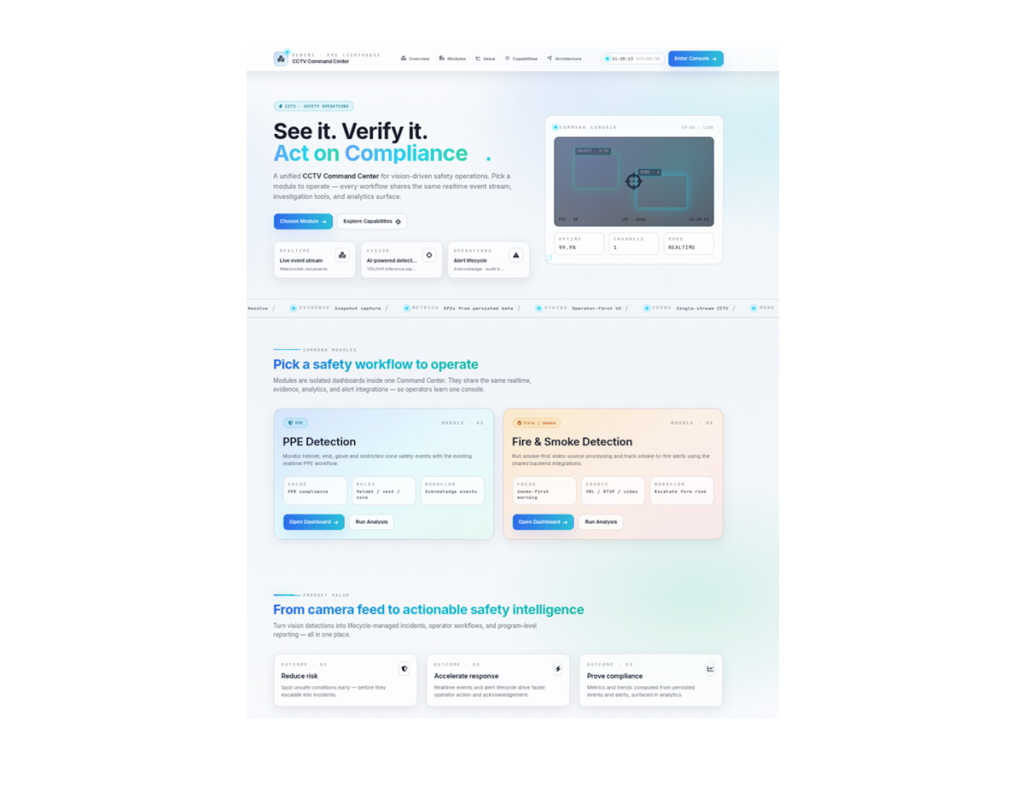
The AI then generated a premium enterprise-grade React + TypeScript frontend, purpose-built to communicate fire incident intelligence, operational awareness, and AI-powered decision support — inspired by Palantir Foundry, Datadog, and modern NOC command centres. The interface uses a professional dark theme, subtle glassmorphism, Framer Motion animations, and enterprise visual hierarchy rather than generic admin templates.
The dashboard is structured as a ten-section single-page application with smooth scrolling and animated transitions:
- Hero Section: Full-screen animated landing with particle/grid effects, platform branding, and fire safety messaging — optimised for executive demonstrations and stakeholder presentations.
- Live Operations Bar: Sticky system health status bar with real-time indicators for Model, Database, Storage, and WebSocket connectivity using Font Awesome icons and animated status chips.
- KPI Command Centre: Executive glassmorphism KPI cards with count-up animations displaying Total Events, Active Alerts, Fire Detections, Smoke Detections, Combined Incidents, and Zone Distribution.
- AI Video Analysis Centre: Image and video upload interface with real-time detection overlay rendering — bounding boxes, confidence scores, and detection colour coding: amber (smoke), red (fire).
- Real-Time Event Timeline: WebSocket-driven live event feed with staggered Framer Motion insertion animations, severity indicators, snapshot thumbnails, and camera attribution.
- Alert Management Centre: Active alert console with full acknowledge workflow. All actions update instantly via React Query cache invalidation — no page refresh required.
- Evidence & Forensics Viewer: Professional incident review panel with zoom support, bounding box metadata, confidence scores, and event history — designed to resemble enterprise investigation tooling.
- Analytics Dashboard: Animated Recharts visualisations covering fire/smoke detections over time, event trends, alert distribution, detection type breakdown, and camera zone incident frequency.
- Platform Architecture Flow: Animated AI pipeline diagram for stakeholder demonstrations: Camera Feed → AI Detection → Temporal Rule Engine → Event Generation → Alert → Supabase → Dashboard.
- Enterprise Footer: Professional footer with platform version, backend status, model version, and build metadata — no marketing clutter.
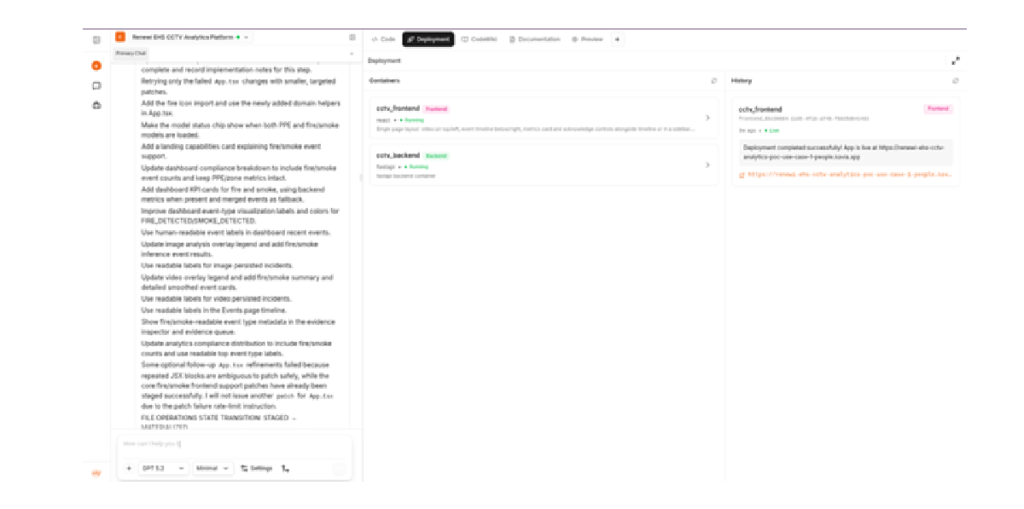
Deployment / Hosting: Production-Grade Orchestration via Kavia AI
The platform bridges enterprise-grade architecture with seamless execution by deploying a production Docker topology natively hosted through Kavia AI. Rather than forcing a choice between raw configuration and automated simplicity, Kavia AI ingests and parses the repository’s underlying Docker Compose deployment topology directly. This eliminates the need for manual cloud infrastructure provisioning or custom DevOps scripting while preserving full architectural visibility.
- Automated Containerisation: Kavia AI automatically builds the FastAPI backend container and handles the compilation of the React frontend to serve it as a high-performance, static Nginx asset.
- Zero-Ops Stack Orchestration: Multi-service dependencies, networking, and environment variables are orchestrated natively with zero manual infrastructure configuration or external cloud overhead (AWS, Azure, GCP).
- Live Operational Runtime: The deployment instantly provisions a secure, live HTTPS URL, instantiates automatic container health checks, and hooks up live log streaming directly to the Kavia AI dashboard.
Architectural Alignment: By leveraging Kavia AI to ingest the team’s production Docker configuration, the entire multi-service ecosystem transitioned from a raw repository to a live, stakeholder-ready environment in under 4 minutes — completely removing manual DevOps friction without abstracting away the underlying system design.
Before vs. After: Transforming Fire & Smoke Safety Monitoring
|
Before — Manual Fire Watch |
After — AI-Powered Detection Platform |
|
Manual fire watch patrols with significant coverage gaps |
Always-on YOLOv8n inference on live RTSP streams — significantly reducing human observer fatigue and coverage gaps |
|
Smoke or fire detected only after visible spread or after scheduled inspection rounds |
Real-time fire and smoke detection (sub-2-second inference) with confirmed-alert delivery to dashboard within ~2–4s end-to-end, after temporal persistence validation |
|
No photographic evidence captured at moment of incident |
Annotated incident snapshots auto-generated and stored in Supabase Storage at the exact moment of detection |
|
Emergency response triggered only after prolonged human observation |
Temporal persistence engine confirms genuine fire/smoke events — preventing false positives from reflections or steam |
|
Incident reports written from memory hours after events; incomplete evidence trail |
Complete event records with UTC timestamps, camera ID, confidence scores, and annotated snapshot URLs |
|
No trend analytics or audit-ready reporting on fire/smoke incident frequency |
Executive analytics dashboard with incident trends, zone analysis, and full audit trail |
Team: Human-AI Collaboration
This platform build was brought to life through a lean, high-trust collaboration model between a single human architect and an AI acting as the primary engineer — producing a fully functional, stakeholder-ready AI fire safety monitoring platform in just 48 hours. This synergy delivered a complex, cloud-native CCTV analytics system — encompassing computer vision AI, multi-service backend architecture, enterprise frontend, and production Docker deployment — in a timeline that would typically require 4–6 weeks of sprint cycles across a specialised engineering team.
How the Work Was Divided
- The AI (Architect, Backend Developer, Frontend Developer, QA Engineer): Owned the full engineering scope — Solution Architecture Document generation, HLD/LLD design, FastAPI service implementation, YOLOv8n inference service architecture, Supabase repository layer, React + TypeScript UI across all ten dashboard sections, Docker Compose configuration, health endpoints, and the complete Pytest unit test structure.
- The Human Collaborator (Principal Solution Architect): Provided the critical strategic layer — clarifying fire safety operational context, confirming YOLOv8n model asset selection and production constraints, directing the no-retraining mandate, validating the temporal persistence and deduplication design decisions, and confirming the enterprise dashboard design philosophy against stakeholder presentation requirements.
Conclusion
The Fire & Smoke Detection and Incident Response Platform is a clear demonstration of how structured AI-driven engineering can solve real-world industrial fire safety challenges at enterprise scale and startup speed. By leveraging a pre-trained YOLOv8n model as a production-ready AI asset — and focusing the entire engineering effort on the platform layer, services, and user experience around it — the team delivered a solution that proves AI can build complex, cloud-native, presentation-ready enterprise software in 48 hours.
The platform goes from BRD to a fully operational CCTV analytics system: detecting fire and smoke events in real time, generating photographic evidence, attributing incidents to camera zones for precise location tracking, and delivering live operational intelligence through an enterprise React dashboard — all accessible to HSE directors, site supervisors, compliance auditors, and executive stakeholders through a single browser URL.
More than a technical demonstration, this platform represents a new operating model for fire safety software delivery: one where the engineering timeline is measured in hours rather than months, architectural quality is not traded for speed, and every platform requirement — from SOLID backend architecture to Framer Motion dashboard animations — is delivered to production standard in a single structured collaboration workflow.
See What We Built
The Fire & Smoke Detection & Incident Response Platform went from BRD to a fully functional, stakeholder-ready demonstration build in under 2 days, with the engineered platform layer — FastAPI backend, Supabase data pipeline, and React dashboard — built to production standard, using AI as the primary engineer across architecture, backend, frontend, and deployment. Want to see what your fire safety platform requirements can become?
Contact us to discuss your production use case build — connect@digitalt3.com