
Accelerating GxP Application Engineering with Kavia AI: DigitalT3’s 2-Day BRD-to-Build Blueprint for Highly Regulated Platforms
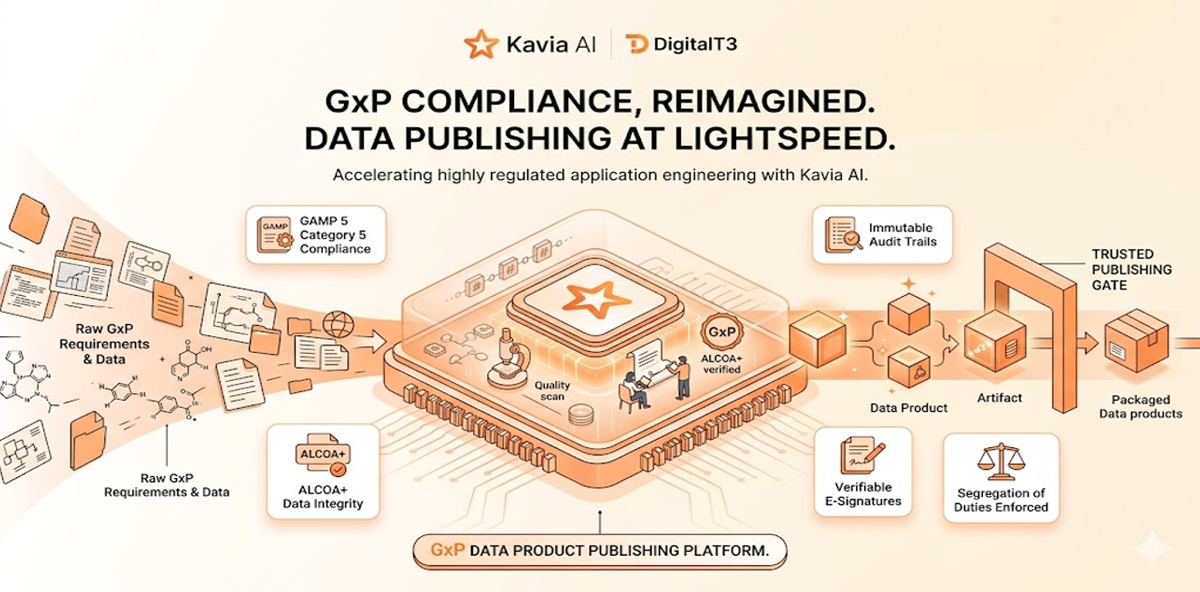
This production use case build demonstrates DigitalT3’s GenAI SDLC in action: an industrial-grade GxP Data Product Publishing Platform, architected directly from a complex Business Requirements Document (BRD) and derived from a v2.0 Compliance Rule Book, into a fully functional, tested, and auditable application in just 2 days. What typically requires months of human sprint cycles and high regulatory risk was executed autonomously, with Kavia AI as the primary engineer and architect.
Managing data integrity within highly regulated industries like life sciences and pharma is arguably one of the most process-heavy, manual-intensive software challenges. Validating that a platform operates in a continuous state of regulatory compliance requires exhaustive controlled submission, exhaustive validation, and immutable audit trails that are nearly impossible to maintain manually or with standard CMS tools.
DigitalT3 tackled this high-stakes engineering problem head-first. We deployed the Kavia AI Agent to build a new GxP Data Product Publishing Platform—a bespoke, GAMP 5 Category 5 custom application that guarantees data integrity (ALCOA+), automatically enforces fine-grained policy gates, and produces the mandatory, immutable “Evidence Packages” that underpin regulatory audits. What follows is the detailed account of how Kavia AI compressed this massive engineering effort into just 48 hours.
Target
Purpose and Value Proposition
The core mandate for trust in published data within life sciences is strictly defined by regulations like 21 CFR Part 11 and ALCOA+ principles. Manual compliance review workflows are fragile, introducing significant risk during data submission, validation, and stewardship review. Relying on disjointed spreadsheets, manual Electronic Signatures (e-signatures), and basic content tools leaves massive traceability gaps and requires a huge duplication of engineering and testing effort.
This platform was engineered to eliminate those gaps. By leveraging Kavia AI to ingest and translate complex regulatory requirements—specifically derived from an existing GxP-Aligned Compliance Policy & Rule Book v2.0—into a fully governed, automated application, DigitalT3 delivered a system that enforces Mandatory Quality Gates instantly and maintains a GAMP 5-compliant Requirements Traceability Matrix (RTM). This guarantees that every published data product is backed by unrepudiated, immutable evidence, satisfying the “ALCOA+” standards for trust while drastically reducing the time and cost of compliance review.
How It Can Be Used
- Data Publishers: Access a guided self-remediation portal to submit datasets, instantly view validation errors (e.g., Schema drift, stale data), and fix failures before they block the workflow.
- Data Stewards / Owners: Utilize a prioritized internal dashboard with quick deviation-management workflows to review business context and electronically e-sign approvals with full traceability.
- Quality / Validation Owners: Execute full audit readiness by inspecting evidence packages, tracing TC (Test Case) IDs back to originating URS (User Requirements), and monitoring portfolio integrity via immutability checks.
Value Provided
- Requirement-to-Code Precision: The Kavia AI Agent mapped every high-level user need (URS) and functional requirement directly to production API endpoints and Pytest test cases, including specific ALCOA+ principles. Every logic flow, from e-signature re-authentication to Segregation of Duties logic, was implemented with perfect fidelity to the v2.0 Rule Book.
- Sub-3-Second Compliance Review: The automated mandatory quality gater (FR-05) executes in under 3 seconds per check, delivering an instant pass/fail status for Schema, Freshness (<24h), and Completeness (<0.1% Null critical IDs).
- Airtight GxP Integrity by Default: ALCOA+ enforcement is embedded from day one: hash-chained JSON evidence packages are auto-generated and hashed (SHA-256) for immutability; audit trails log timestamp (UTC) and IP address; and e-signatures are fully verifiable.
- Fully Governed Deployment Pipeline: An automated CI/CD pipeline ensures every pull request and configuration change (e.g., max age limit) is traceable and auditable via OpenAPI drift checks, providing zero-touch, structurally complete deployment to standard cloud environments.
Technique: The Kavia AI Streamlined Workflow
The technique used to build this platform represents a fundamental shift in the highly regulated software development lifecycle (SDLC). We collapsed traditional engineering timelines by positioning the Kavia AI Agent as the lead architect, lead backend developer, lead frontend developer, and primary QA/Validation engineer.
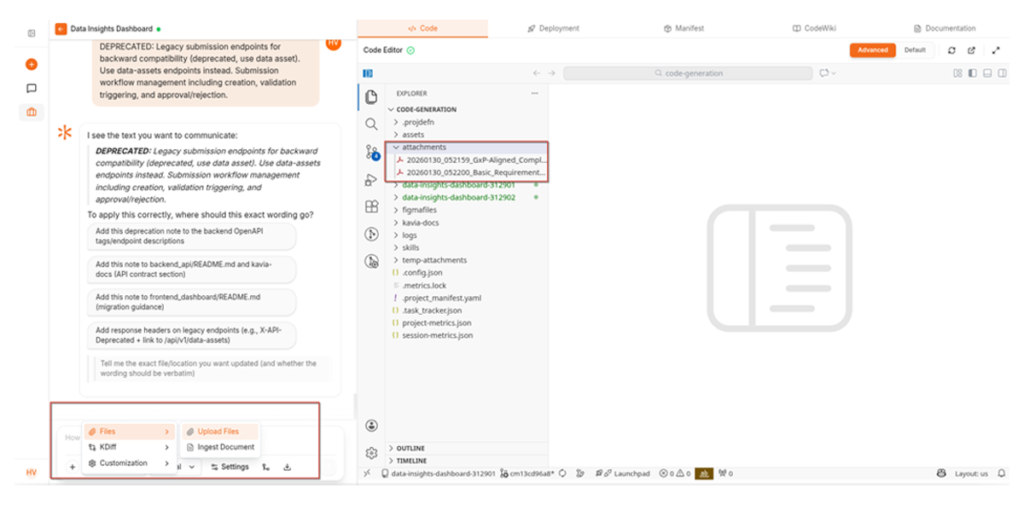
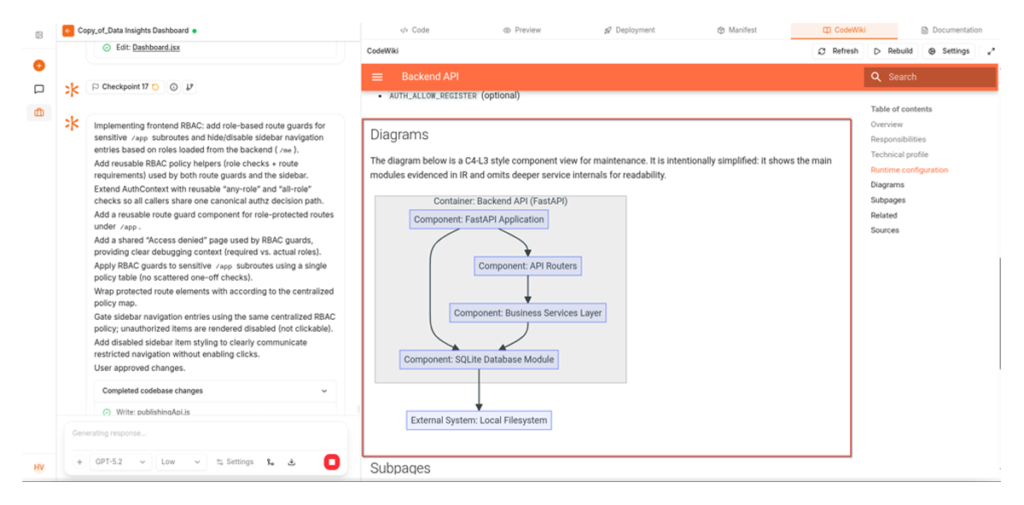
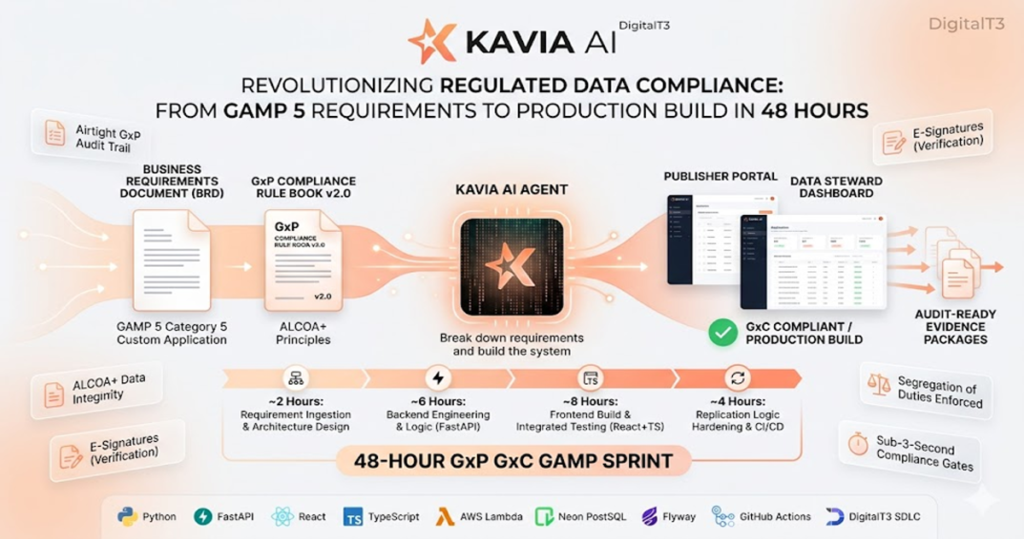
Crucially, the Kavia AI Agent did not just “write code.” It acted as the lead architect and planner, ingesting both the complex BRD and the derived v2.0 GxP Compliance Rule Book. The Agent utilized CodeWiki to maintain a living “Single Source of Truth” for the project, which included the automated functional decomposition of all functional (BR-001 through BR-008) and non-functional requirements (NFR-001 through NFR-003).
This rigorous, AI-driven planning phase eliminated the “requirement drift” that often plagues human-led projects in regulated sectors, ensuring that the critical standards for Traceability (linking TC to URS ID) were architected right the first time.
Below is the high-velocity pipeline Kavia followed to build the GxP Data Product Publishing Platform:
Project Timeline and 2-Day Build
1. Requirement Ingestion and Design
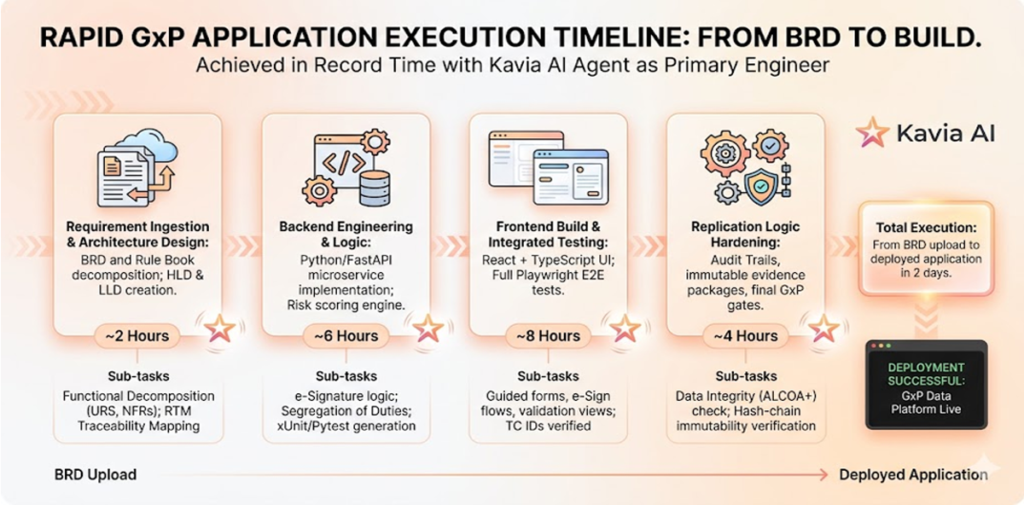
Kavia AI ingested the complex BRD and the v2.0 Rule Book, performing an automated decomposition into specific user stories and technical tasks. Within minutes, the Agent drafted the High-Level (HLD) and Low-Level Designs (LLD). It generated detailed sequence diagrams for complex operations like the e-signature workflow and Segregation of Duties logic, ensuring absolute transactional integrity across submission, stewardship review, and quality owners.
2. Backend Implementation and Logic Hardening
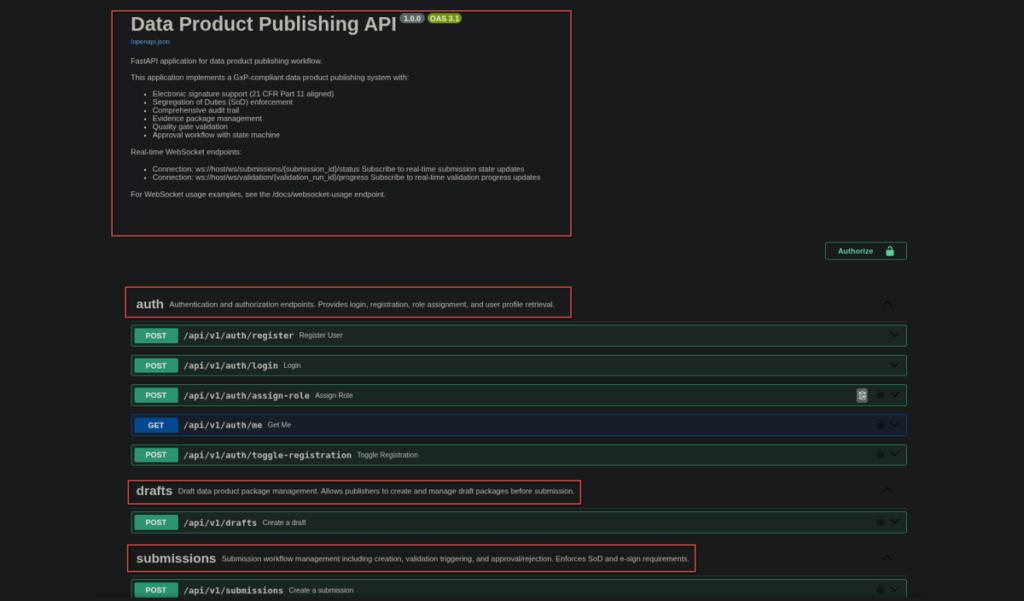
With the blueprint in place, the Agent implemented the backend as a robust Python microservice architecture using FastAPI. It established the strict functional logic derived from the Rule Book: transactional boundaries for e-signatures, unified “Problem Details” responses for backend exceptions, and the three mandatory GAMP Quality Gates. Data was persisted in AWS S3 and Azure Blob mocks for evidence package archival. All schema changes were versioned via Flyway migrations. For quality assurance, the Agent automatically generated a comprehensive suite of Pytest tests (verified with coverage reports) for route wiring and validation logic.
3. Frontend Build and Integrated Testing
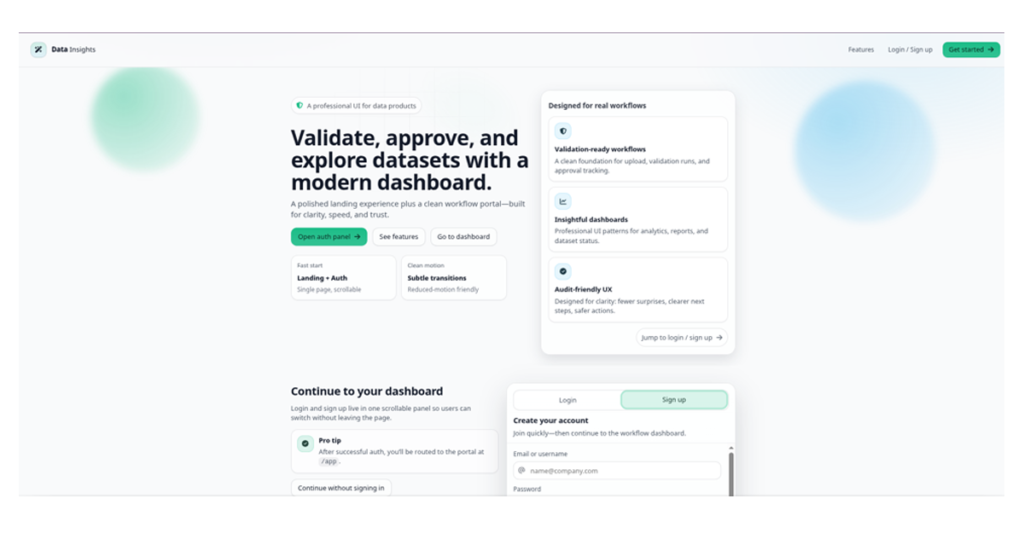
Kavia then generated a React + TypeScript frontend, tailored to provide distinct and type-safe user experiences. The Publisher Portal features a “wizard” style guided submission form, real-time validation error views, and a secure drag-and-drop file upload interface. The Data Steward Dashboard was engineered to manage the prioritized list of submission drafts and the quick deviation waiver e-sign flow, reducing the current high abandonment and high manual data entry levels. Deterministic state management patterns were implemented to handle complex e-signature re-authentication states without data loss. Finally, the Agent authored a full set of Playwright E2E tests to automate verification of the entire user journey.
4. Cloud Deployment and Governance
To ensure a secure, scalable, and audit-ready production environment, the platform was deployed using a serverless AWS Lambda architecture for the backend API.
The entire deployment pipeline was managed via GitHub Actions for CI/CD, providing automated OpenAPI drift checks and security gates. Neon PostgreSQL provided a scalable, serverless database layer, and Flyway was utilized for database versioning, ensuring that all schema changes are tracked and reversible. This methodology ensured that the final deployed application was structurally complete and source-safe.
Team: Human-AI Collaboration
This platform build was brought to life through DigitalT3’s lean, high-trust collaboration model between a single human collaborator and the Kavia AI Agent, producing a fully governed regulatory-grade application in record time. This synergy allowed us to deliver a complex, bespoke GAMP 5 Category 5 solution in just 48 hours—an outcome that typically requires 4–6 weeks of sprint cycles.
How the Work Was Divided
- The Kavia AI Agent: Architect, Backend Developer, Frontend Developer, and QA Engineer. Owned the full engineering scope — CodeWiki planning, HLD/LLD design, FastAPI API development, React + TypeScript UI across both platform experiences, and the complete Pytest and Playwright test suites.
The Human Collaborator: Provided the critical strategic layer, clarifying high-stakes GxP validation context, and confirmed the GAMP 5 validation rules and compliance standards derived from the v2.0 Rule Book.
Conclusion
The GxP Data Product Publishing Platform is a clear demonstration of how DigitalT3 combines cutting-edge AI with enterprise-grade architecture to solve real-world regulated challenges. By leveraging AI for everything from HLD/LLD planning to integrated frontend testing, and Python/FastAPI for a resilient backbone, we have delivered a solution that proves AI can build complex, source-safe, reporting-ready enterprise software at lightning speed today.
See What We Built
This GxP Data Product Publishing Platform went from BRD to a fully functional, production-ready application in under 2 days, using Kavia AI as the primary engineer. Want to see what DigitalT3 can build for your requirements?
Contact us to discuss your production use case build — connect@digitalt3.com
DIGITALT3 remains committed to Bringing Digital and AI Together and enabling adoption across industries. For more information, visit our website at digitalt3.com.